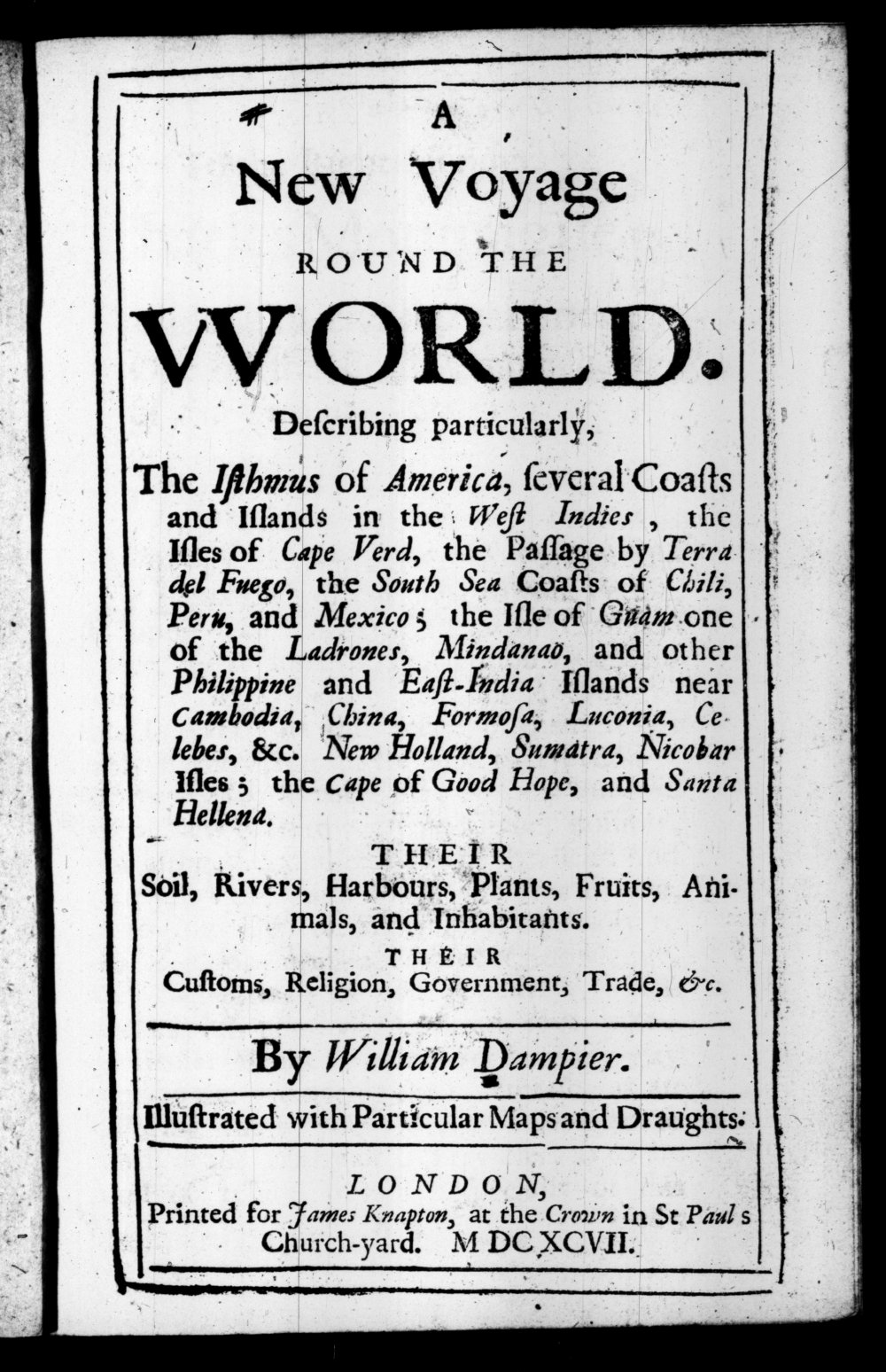
A New Voyage Round the World by William Dampier, 1697 Edition
Jump to Chapters.
Intro of this site
This site includes all the pages of the book in images 📸, and text 📄 extracted from these images by latest AI.
The text of each page is then systematically validated against the image, with old words or words with old meaning commented below the paragraph, AI generated illustrations[1] to aid cognitive processing and retention, and modern names of old places on Google Maps to offer geographic context.
1. Illustrations helps giving great clarity of things or scenes described, and a strong association (in memory) with the page where to pinpoint the things or events in a later time.
The image materials came from the pdf downloaded from archive.org; if you just want a general viewing of the original book, you can read and download it there.
This website is a specialized, long-term, in-process study project of this specific edition. The goal is to have a deep familiarity and understanding of this great book - which sits at a very unique position between adventure, piracy, and science (navigation, geography, botany, zoology, culture, people, ...) 300 years ago - and to make it much more accessible for possible future (far into the future) interested parties.
You can submit issues, errors, or suggestions using the form in each individual page. No personal info or format required; the infrastructure of the website is very solid, if the submit is successful, I will 100% see it and take it seriously. This is not a big commercial service, any visitor's feedback will get vip treatment.
Intro of W. Dampier, & why it's necessary
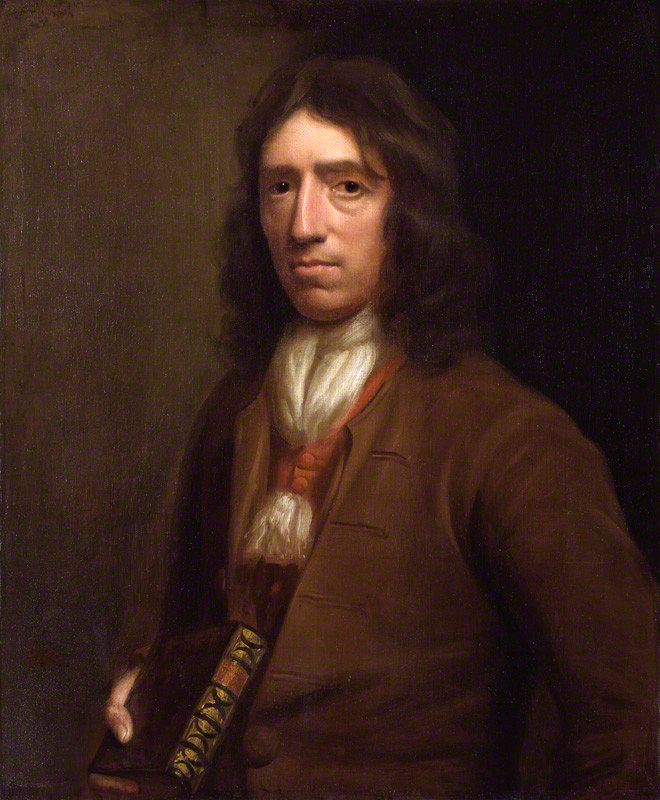
I shouldn't have to introduce William Dampier, but since the whole world knows Robinson Crusoe but not Old Dampier, it's necessary to put in some context first.
This man is an adventurer, pirate, scientist, travel-cum-scientific writer, and the 1st Englishman who circumnavigated the world 3 times.
He was there in the Golden Age of Sailing, fighting 🏴☠️⚔️🌊 and barbecuing 🔥🐠🥩🥥 (dude considers coconut the King of Fruits) with legendary pirate captains in the Caribbean.
He was also there in the very beginning of Scientific Thinking & Writing - empirical observation (backed by real data and logical analysis) over funny theories (based on, well, a serious lack of data).
He captained the 2nd[1] ever sailing expedition (to Australia) purely for the purpose of science[2].
1. Halley's 1698 voyage aboard HMS Paramour is the first purely scientific voyage. However, Dampier's 1699 voyage aboard HMS Roebuck holds many monumental firsts of its own; his methods also became operational blueprint later adopted by many famous captains on similar voyages. To be more nuanced, the two unprecedented expeditions - led by civilians given naval commissions for the specific purpose of science - were authorized around the exact same time by the Admiralty, Dampier was approved first and given a bigger ship, but he also suffered more delays due to various reasons. He was, however, undoubtably the first pirate who was commissioned as a naval captain for an official scientific expedition.
2. Because the viewpoint of his book - adventure, AND nature (including geography and culture), with simple scientific language and unbiased documentary reporting - was genuinely refreshing, insightful and informative, and highly confirmative to the ideals of the Royal Society, he was introduced to very important individuals (intellectual elites, scientists, naval officers, ...), and like a true Briton, he capitalized this opportunity and presented the proposal/idea.
His book A New Voyage Round the World 🆕⛵️🌎 was a massive sensation, providing immediate and actionable geographic intelligence for the British public and government, both with great appetites (the timing was perfect), and inspiring current and future explorers and scientists.
This man put Piracy & Science 🏴☠️🧬, the coolest things, in one book.
He more than directly inspired Daniel Defoe[1], Charles Darwin[2], Capt. Cook, Adm. Nelson, ..., his books were required reading in the Royal Navy for its maritime knowledge and accuracy.
1. Robinson Crusoe's real life inspiration was Alexander Selkirk. Dampier not only sailed with him, knew where he was marooned, and was the pilot of Woodes Rogers expedition that rescued him. On the same island, 20 years before Selkirk, a Moskito Indian named William, was also left there for years, and was also rescued by the expedition Dampier was in. 10 years after Selkirk, Defoe wrote his famous book. There are many similarities between the two books, you could even say Crusoe is a fictional version of A New Voyage - same voyage narrative but focused more on adventure, industrial and colonial spirits.
2. Charles Darwin had this book with him on the Beagle 150 years later, meaning he carried it around the world. He cited Page 103 about turtle doves on Galápagos in his journals, and later used Galápagos observations as evidence in On the Origin of Species but did not quote him in the latter.
It's safe to say the Golden Age of Inquiry (age of discovery, enlightenment, and scientific revolution) is also the Golden Age of Sailing 🤔🟰⛵️.
Obviously, adventure and commerce (ultimate forms of communication) have always been the best teachers. (No culture allowed such luxury has not been thriving and lively.)
Thus, England was a very open-minded and industrious country at that time, and Dampier was most celebrated as well. But since then, he basically disappeared in public education. We are still very open today, but the world is not free market any more.
Great things about this book, & this particular edition
This year is 2026 2️⃣0️⃣2️⃣6️⃣, meaning the book is published a bit over 300 years ago. Its language is surprisingly modern - actually termed early-modern English (where spelling was often fluid and phonetic) - everybody can understand it with no big problem especially with the help of modern AI (summary, translation, and other analysis).
The amazing thing about the formatting in this edition is, every line is very short and every page is very digestible. 500 pages, 20 chapters, on average 25 short pages a chapter.
You will notice, during that time English words, both sounds and spelling, were not formalized. At the peak of Age of Sailing, numerous places were discovered and named by different nations, and perhaps multiples times. And then later heard by people from different languages, who often had to translate the words in sounds to their own informal spelling.
What this means - the spelling consistency is nothing like today, and the same places might have all kinds of names - sometimes similar, sometimes not at all similar. But, what I came to appreciate, is that all these mistakes are very, very tolerable, and in a way makes it much more interesting. You can feel that, English, French, Dutch, Spanish, ..., all these people from very different places, explore, fight, pirate, communicate, trade, ..., it's very dynamic and interesting.
But even if we do not live in that golden time and place, when and where we do not have the seemingly endless options like today for entertainment but not enough time, it actually could be a great thing having not many options, which gives us all the time and helps us focus on one great book or one thing, therefore naturally resulting in very high "tolerance for mistakes". In that sense, this edition is perfect to me with all its imperfections.
Chapters
Greatest song about sailing
And last, the greatest song ever written about sailing/pirates:
What's perhaps even better is - this song is written by a native French woman, in English lyrics, and sung in English. Sort of like Jules Verne chose his hero an Englishman and the servant a Frenchman in 80 Days Round the World , suggesting in recent history English and French were inseparable in culture and ties.
Some say it's "the best song ever", I can't say that but it's certainly one of the best without a doubt.
A 2nd best that I know of is:
Notice the German surname.
And a personal or generational note, the "lighted window" feels to me is simply the tv, upon which the generation of mostly lower-class kids who grew up on their parent's indulgence (or negligence, depending on your perspective) and Lizzie McGuire, Smallville, MVP Valentine, National Geographic, ..., 90s' kids understand what i'm sayin'.
Nat Geo Asia Specials certainly took it very seriously in the early 2000s, the themes are still the best I ever saw. Not only the yellow frame is like a lighted window or tv, but also the theme of this video aligns very well with Dampier's book:
Don't ask me why they are all women, I don't control these things. In this case, they are simply the best.
A less enthusiastic intro
I have asked both Gemini and ChatGPT for opinions of this home page.
Gemini never seemed to have a problem, but the more independent and focused ChatGPT (I'm not saying it's better, best I can say is - they both have their strenths) says that my wordings are informal and a bit too enthusiastic.
Well, becoming a pirate is a bit too enthusiastic for a (poor) scientist to explore, innit? (I'm kidding ... although this website certainly came out of some serious interest and efforts.) Their opinions are important to me, as long as they are obviously right 😉.
Anyway, here is a very short summary of what is this book and who is William Dampier, in a traditional and perhaps academic-like tone, with less enthusiasm for the purpose of scientific seriousness and credibility:
A New Voyage Round the World is a famous 1697 travel memoir and natural history account, written by the English buccaneer, explorer, and naturalist William Dampier.
Note that, in simple modern language with clarity of modern scientific understanding - buccaneer is simply a pirate, and naturalist is simply a scientist.